Aviary Attorney is a courtroom detective game set in Paris in 1848, and it turned out to be a surprisingly good workout for critical thinking. No spoilers ahead.
I recently finished it, and I want to explain why it's worth your time without giving away a single case. You won't find culprits, twists or endings here. Just what the game asks of you, and why that's good for the way you think.
In short
- Every testimony is a claim you test against evidence. That's critical thinking in its purest form.
- You only get a few days before each trial, so you learn to prioritize what to investigate.
- Losing a case doesn't end the game. The story continues, and you live with the result.
- The setting, art and music are all from 19th-century France, so you pick up some history along the way.

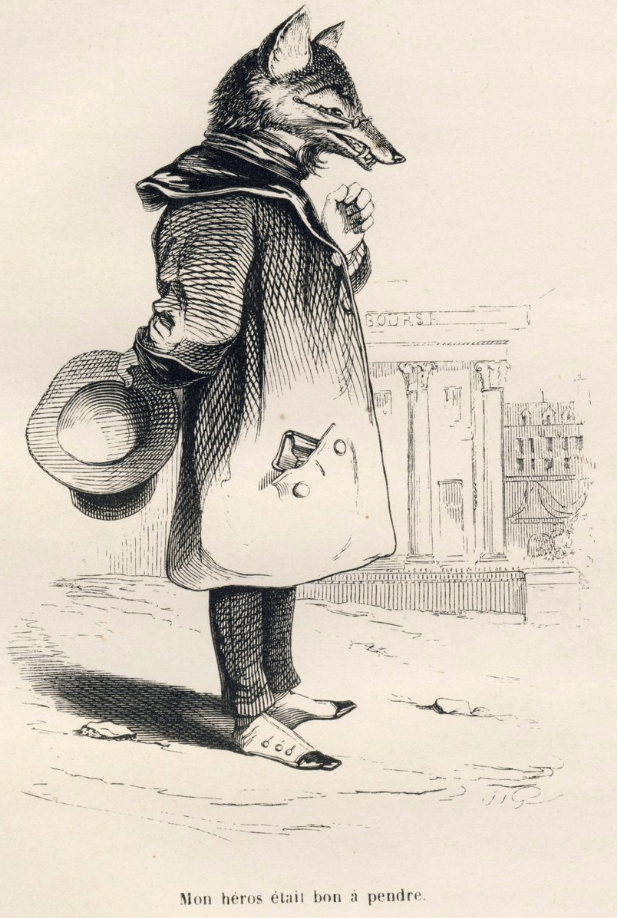
"Mister Vulture" by J. J. Grandville, 1840. The whole game borrows its look from Grandville's satirical animal drawings. Metropolitan Museum of Art, public domain via Wikimedia Commons.
What is Aviary Attorney?
Aviary Attorney is a detective visual novel by Sketchy Logic, a small UK studio made up of Jeremy Noghani and Mandy Lennon. It was funded on Kickstarter, released on Steam for Windows and Mac on 21 December 2015, and came to Nintendo Switch as a Definitive Edition on 30 January 2020.
You play Monsieur Jayjay Falcon, "a bird of prey with a good heart and questionable lawyering expertise", as the Steam page puts it, together with his witty apprentice Sparrowson. If you know Ace Attorney, the loop will feel familiar: take on a client, investigate around Paris, collect evidence, then cross-examine witnesses in court until the truth comes out. The game has four chapters and three full endings.
What makes it stand out is the presentation. The characters come from the drawings of the caricaturist J. J. Grandville, and the soundtrack is the music of Camille Saint-Saëns. Both are real 19th-century works, and they set the mood before the first case even begins.
How does it train critical thinking?
Every statement in a trial is a claim, and your job is to check it against the evidence. That sounds simple, but it's the core of critical thinking: don't accept a statement because it sounds confident. Compare it with what you actually know.
The game makes you do this precisely. Feeling that "something is off" in a testimony isn't enough. You need the exact line that's wrong and the exact item that proves it. Vague suspicion gets you nowhere, and pressing on irrelevant points costs you credibility with the jury. Careless guessing has a price.
Over time, a useful habit forms. You read a statement and ask: what would have to be true for this to hold? Then you check whether it is. That question works far outside a courtroom, in meetings, in the news, and in your own assumptions.
As someone who builds software, I found cross-examination feels a lot like debugging. A witness is a log message: it tells you what someone believes happened. The evidence is the actual state of the system. When the two disagree, the bug lives in that gap. Finding it takes the same patience in both worlds.
Why does limited time sharpen your analysis?
You only have a limited number of days before each trial, and you can't visit every place or talk to every character. The developers said it plainly in an interview with Siliconera: you have to choose carefully where to go.
That changes how you play. Instead of clicking on everything, you plan. What do I already know? What's still missing? Which lead is most likely to close that gap? It's analysis with an opportunity cost attached to every choice.
It also teaches something most games avoid: you'll rarely have complete information. You walk into court with what you gathered, and you build the best case that evidence allows. Sound familiar? That's how most real decisions work.
What happens when you make the wrong call?
Losing a case does not end the game. The story moves on, and the mood, the dialogue and later events shift depending on how earlier cases went. The Steam page sums it up in four words: "Decisions have consequences!"
This is where Aviary Attorney differs most from its inspiration. In most games, failure is a reset button. You load a save and try again until you win. Here, a mistake becomes part of your story. You carry it forward and deal with it, much like real life, where you can't reload a bad meeting.
That's also where self-reflection kicks in. After a case goes wrong, you start asking honest questions:
- Did I miss a piece of evidence because I rushed?
- Did I trust a witness too quickly?
- Did I pick the obvious answer because it felt comfortable?
This look back is the "self" part of critical thinking, and the game gets you there without ever lecturing you.
My advice: play your first run without reloading saves. Accept what happens. The ending you earn means more than the one you force.
Does it make you think outside the box?
Yes, and at the right moments. Some problems can't be solved by the most obvious reading of the evidence. An item you've carried around for a while can suddenly mean something different once you look at it from another angle.
Without spoiling anything: when you're stuck, the answer is often not "find more evidence" but "question an assumption you've already made". Which detail did you take for granted? Which statement did you accept without checking? Breaking out of your first interpretation is a skill, and Aviary Attorney practices it with you.
What does it teach about French history?
The game is set in Paris in 1848, a city that is, in the words of its Steam page, "on the brink of yet another revolution". France was a monarchy under King Louis-Philippe at the time, and that political tension runs through the story. You also visit real landmarks such as Notre-Dame and the Louvre.
The history isn't only in the plot. Grandville's drawings come largely from Scènes de la vie privée et publique des animaux (Scenes from the Private and Public Life of Animals), published in the early 1840s with texts by writers including Honoré de Balzac and George Sand. The book used animals to mock French society of exactly that era. The music comes from Saint-Saëns, including The Carnival of the Animals. So even the look and sound of the game are a small history lesson.
It's not a textbook, and it doesn't pretend to be. But you come away with a feel for the period, its people and its tensions, and probably the curiosity to read more. One tip: if you're very spoiler-sensitive, save the history reading for after the credits.
What should you know before you start?
A few honest notes, so your expectations are set right:
- It's text-heavy. There's no voice acting. On Steam, English is the only language.
- It's compact. Four chapters is short compared to an Ace Attorney game, and a few critics at launch counted that against it. I see it differently: there's little filler, and three endings give you a good reason to replay.
- The humor is gentle. Expect plenty of bird puns. The Steam page promises "more bird puns than you can shake a feather at", and it delivers.
- Platforms: Windows and Mac via Steam, and Nintendo Switch.
Who should play Aviary Attorney?
It's a great fit if you:
- enjoy mysteries and like to solve them yourself instead of watching
- loved Ace Attorney and want something with more weight behind your choices
- like history, art or classical music, and enjoy seeing them used in an unusual way
- want a game that trains careful reading, logical argument and honest self-reflection
Verdict
Aviary Attorney is more than a funny game about bird lawyers. It asks you to test claims against evidence, prioritize under time pressure and live with the results of your decisions. Along the way it shows you Paris in 1848 through the eyes of a 19th-century caricaturist, set to the music of Saint-Saëns.
If you want a game that makes you a slightly sharper thinker, and occasionally makes you step outside your first idea, this is an easy recommendation. Play it slowly, take notes, and don't reload when things go wrong.
Sources
- Steam store page, Aviary Attorney (release date, platforms, chapters and endings)
- Siliconera, Talking Bird Lawyers And The Unusual Origins Of Aviary Attorney (developers, limited investigation days, losing cases)
- Hyperallergic, 19th-Century French Caricatures Reinvented in a Game About Bird Lawyers (Grandville, Saint-Saëns, setting)
- Nintendo, Aviary Attorney: Definitive Edition (Switch release)